
EURUSD
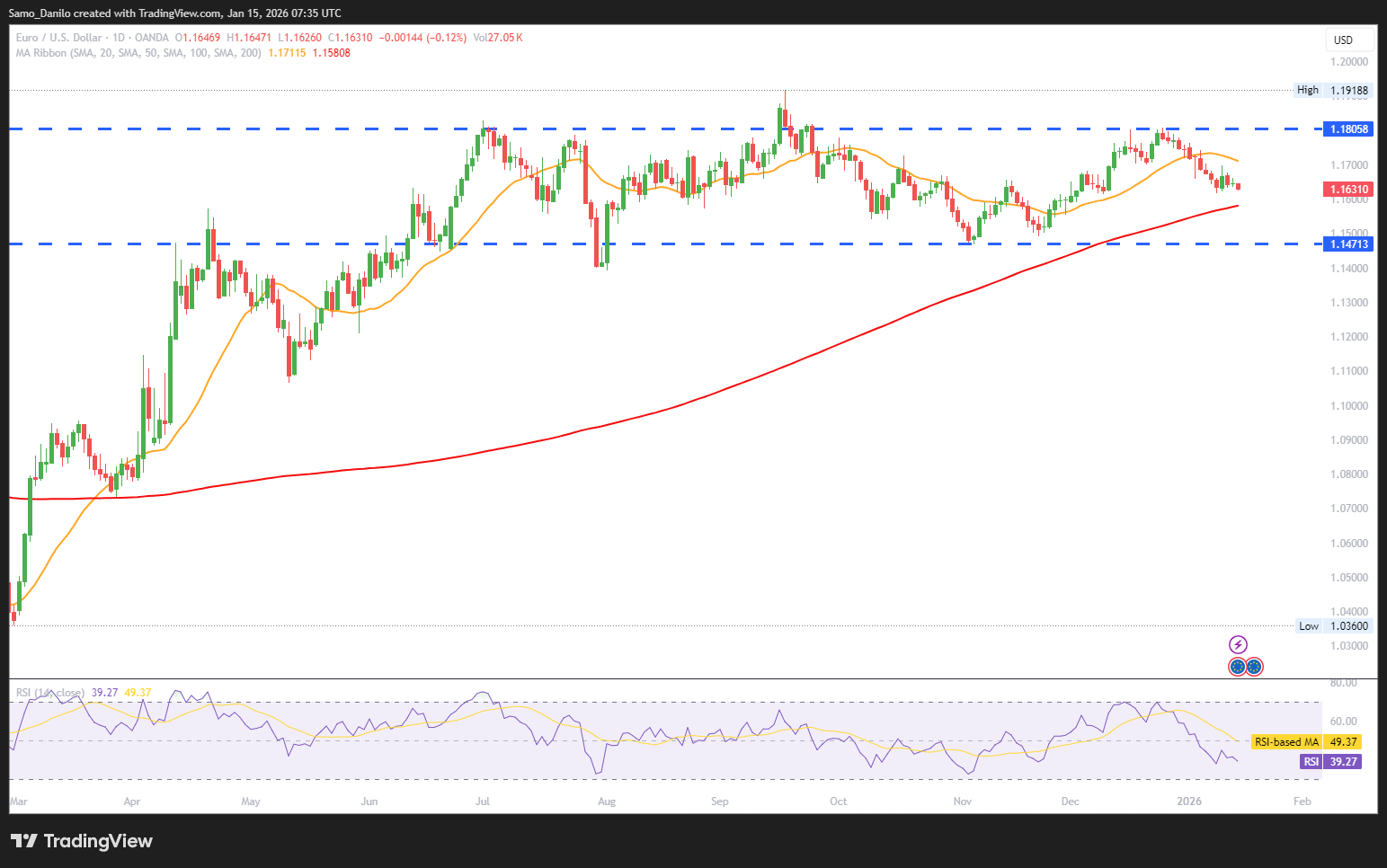
- EUR/USD Price: EUR/USD extends losses for a third straight session, trading near 1.1630, reflecting persistent downside pressure and a firm US Dollar.
- ECB communication: ECB Vice President Luis de Guindos warned that markets are underpricing global uncertainty, with geopolitical risks skewing growth risks to the downside, comments that lean cautiously dovish for the Euro.
- Policy uncertainty: ECB Governing Council member Mārtiņš Kazāks emphasized elevated uncertainty and the risk of non-linear shocks, reinforcing a wait-and-see stance rather than a hawkish pivot.
- Political backdrop: French budget uncertainty remains a mild drag on sentiment, even if passage without parliamentary approval could limit near-term disruption.
- Retail Sales: US Retail Sales beat expectations (+0.6% m/m), underscoring resilient US consumer demand and reinforcing USD strength.
| SMA (20) | Slightly Rising |  |
| RSI (14) | Slightly Falling |  |
| MACD (12, 26, 9) | Slightly Falling | |
Closing statement: EUR/USD remains biased to the downside in the near term, pressured by firm US data and cautious ECB rhetoric. A sustained break below 1.1600 could expose 1.1550–1.1500. Conversely, stabilization above 1.1650 would be needed to ease bearish momentum and allow for a corrective rebound toward 1.1700–1.1730, though the broader tone still favors the USD unless Eurozone data surprise to the upside.
GBPUSD
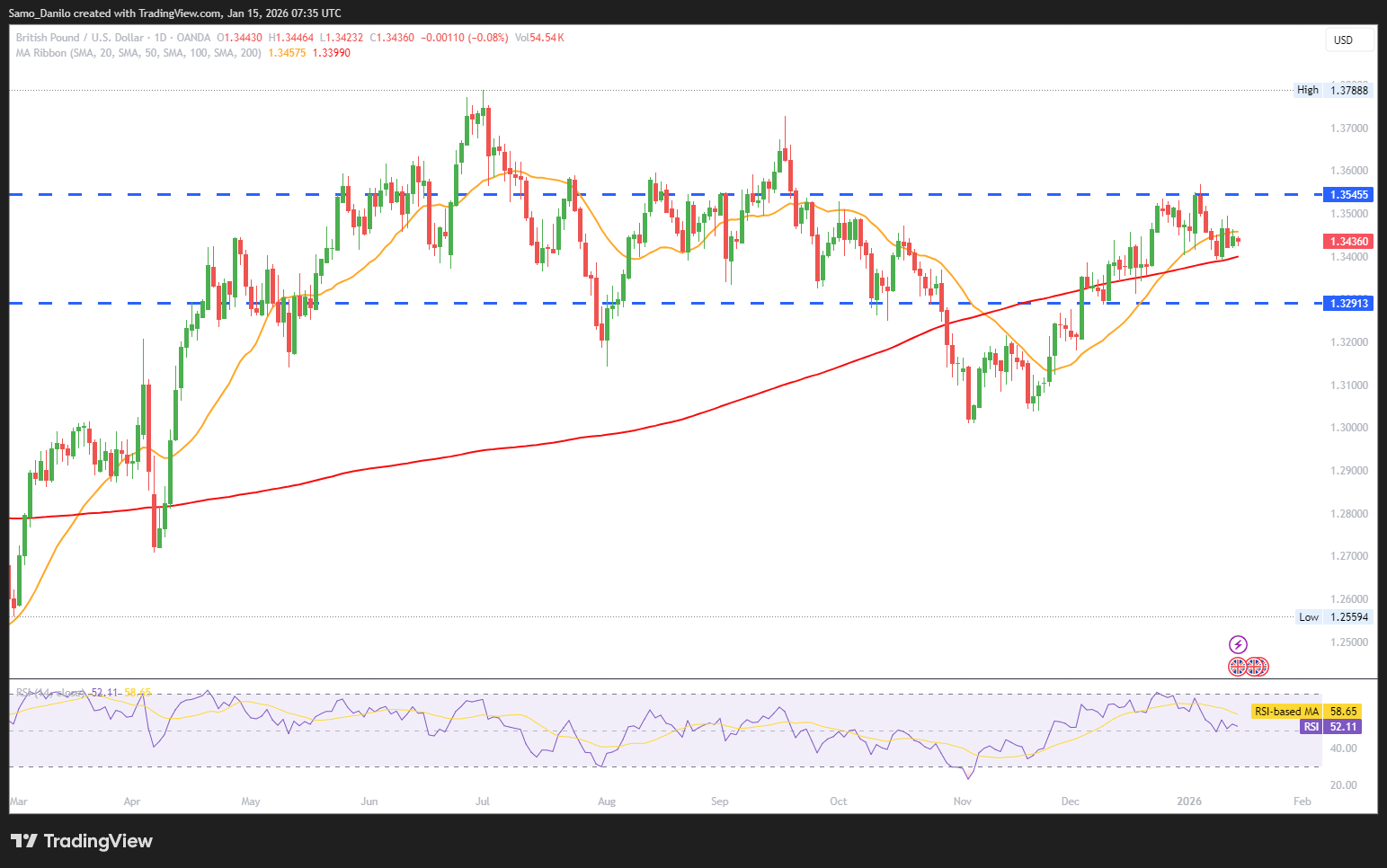
- GBP/USD Price: GBP/USD is consolidating around 1.3430 for a second session, suggesting a pause after recent moves rather than strong directional conviction.
- UK GDP: UK GDP rose 0.3% m/m in November, reversing October’s contraction, signaling that the economy ended the year with improving momentum.
- Industrial numbers: Industrial and Manufacturing Production surged (+1.1% and +2.1% m/m), reinforcing the view that activity picked up meaningfully late in 2025.
- US inflation: US PPI surprised to the upside, with both headline and core at 3% y/y, underpinning the US Dollar via higher-for-longer rate expectations.
- Rates repricing: In response to firm US data, Morgan Stanley pushed expected Fed rate cuts to June and September, supporting USD resilience and capping GBP upside.
| SMA (20) | Rising | | |
| RSI (14) | Slightly Falling | |
|
| MACD (12, 26, 9) | Slightly Rising | |
Closing statement: GBP/USD is likely to remain range-bound in the near term, supported by improving UK data but capped by a firmer USD backdrop. A sustained move above 1.3500 would be needed to revive bullish momentum toward 1.3550–1.3600. Conversely, failure to hold 1.3400 could open the door for a pullback toward 1.3320–1.3300, especially if US inflation data continue to surprise on the upside.
XAUUSD
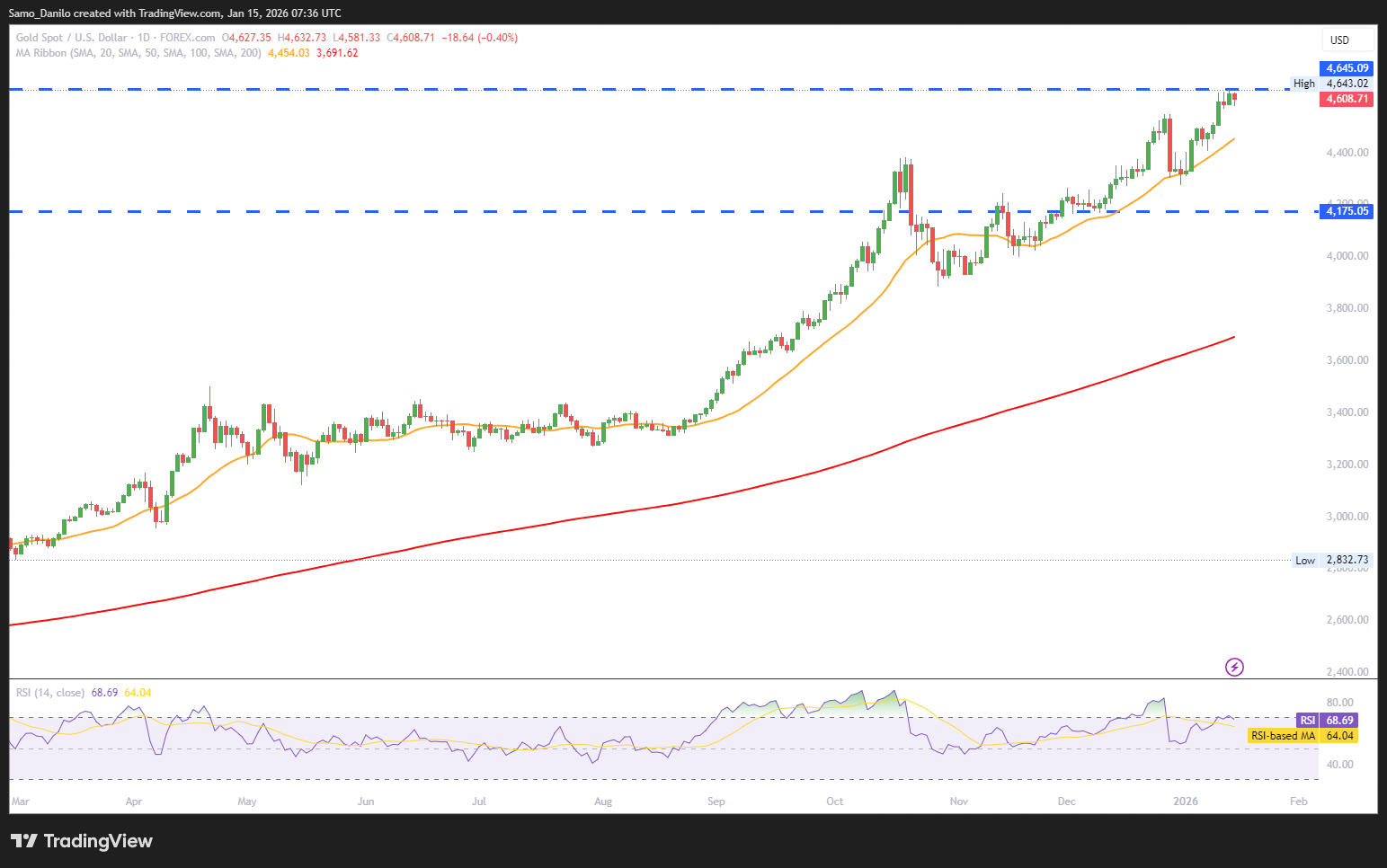
- XAU/USD Price: Gold is pulling back to around $4,610/oz after printing a fresh record high at $4,643, signaling near-term profit-taking rather than a trend reversal.
- Fed narrative: Minneapolis Fed President Kashkari noted the economy remains resilient with less tariff pass-through than expected, slightly reducing immediate downside growth fears.
- Fed's Bostic: Atlanta Fed President Bostic emphasized that inflation is still well above target and argued policy must remain restrictive, supporting higher real yields and weighing on gold.
- Dovish divergence: Fed Governor Miran and Anna Paulson struck a strongly dovish tone, suggesting inflation could fall to 2% by year-end and calling for aggressive rate cuts, which continues to underpin longer-term gold demand.
- Rates repricing: Money markets trimmed the odds of a near-term Fed rate cut, providing short-term headwinds for gold after its sharp rally.
| SMA (20) | Rising | | |
| RSI (14) | Rising | | |
| MACD (12, 26, 9) | Rising | | |
Closing statement: Gold’s retreat looks like a healthy consolidation after record highs, driven by mixed Fed messaging and a modest repricing of rate-cut expectations. As long as prices hold above the $4,550–4,580 support zone, the broader bullish structure remains intact. A renewed drop in yields or a shift back toward dovish Fed pricing could open the door for another attempt at $4,650 and beyond, while sustained hawkish signals risk a deeper correction toward $4,500.
CRUDE OIL
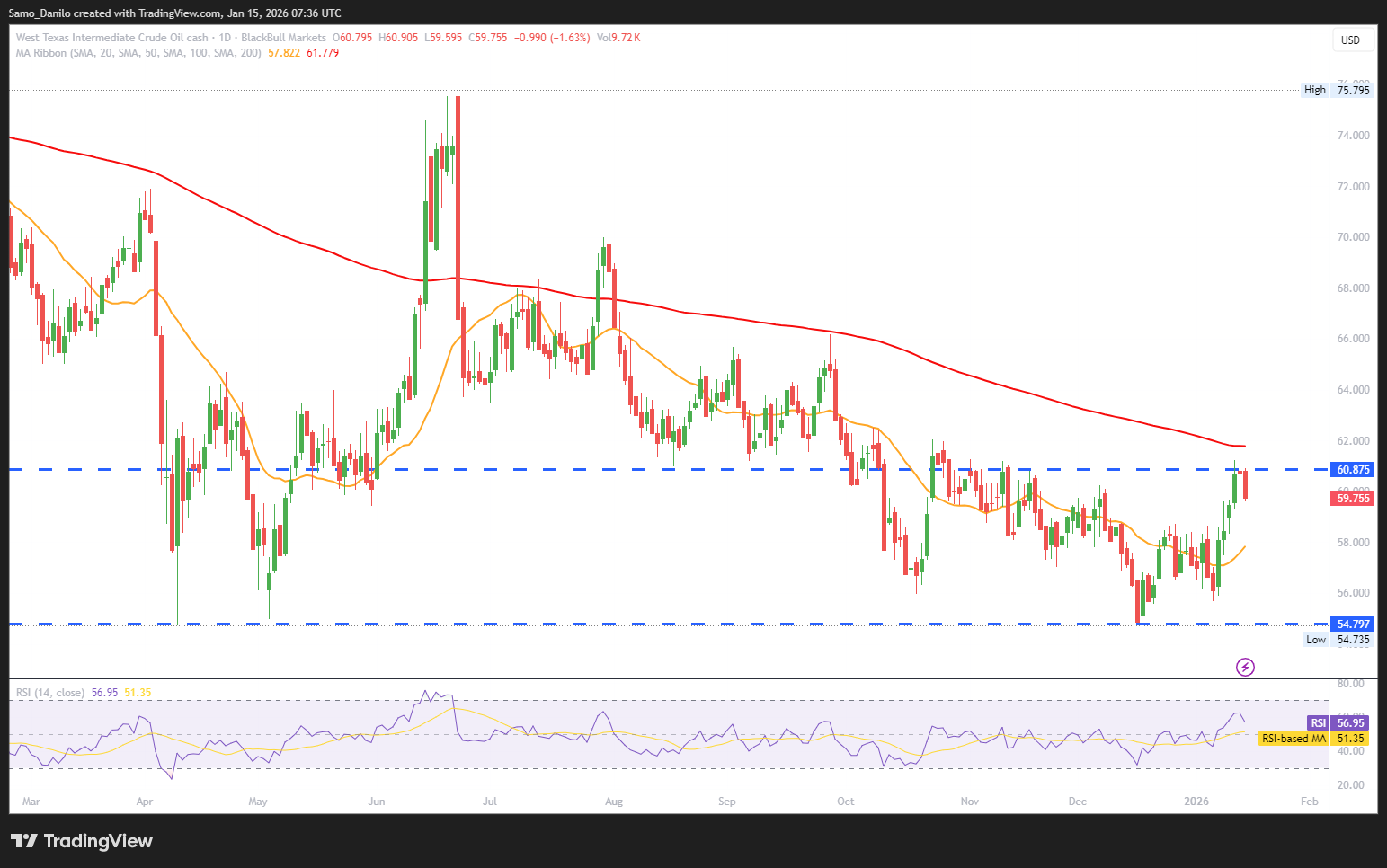
- Crude Oil Price: WTI is extending losses for a second session, trading around $59.70/bbl, signaling fading upside momentum after failing to sustain recent gains.
- Geopolitics cooling: President Trump suggested Iran’s crackdown-related killings may be subsiding, slightly easing immediate geopolitical risk premiums, even as the possibility of US military action remains on the table.
- Inventory numbers: The latest EIA report showed US crude stockpiles rose by 3.39 million barrels, reversing the prior week’s draw and reinforcing near-term supply pressure.
- Venezuela supply: Venezuela has started rolling back production cuts as exports resume under US-controlled financial arrangements, adding to global supply expectations.
- Trade policy: Trade tensions have moved into the background despite delayed Supreme Court rulings on tariffs and mixed US–China signals, offering little support to oil prices.
| SMA (20) | Slightly Falling | |
| RSI (14) | Slightly Rising | |
| MACD (12, 26, 9) | Slightly Rising | |
Closing statement: WTI remains under pressure from rising US inventories and incremental supply risks, with geopolitical headlines no longer providing strong upside support. As long as prices stay below the $61–62 resistance zone, downside risks dominate, with scope to test $58–59. A renewed escalation in Middle East tensions or a shift back to inventory draws would be needed to restore a more constructive short-term outlook.
DAX
- DAX Price: The DAX is trading around 25,340, modestly higher after a small correction, suggesting consolidation near record territory rather than a trend reversal.
- Wholesale inflation: German wholesale selling prices rose 1.2% y/y in December, easing from November’s 1.5%, pointing to contained upstream price pressures and offering some comfort on inflation dynamics.
- GDP numbers: Today’s first full-year 2025 GDP estimate for Germany will provide an early read on Q4 growth. While preliminary, it will shape near-term growth expectations for the index.
- France politics: The French government survived two no-confidence votes, reducing immediate political risk in the euro area and supporting broader regional equity sentiment.
- US data: Weekly jobless claims and regional Fed manufacturing surveys (NY, Philly) could influence global risk appetite and indirectly impact the export-heavy DAX.
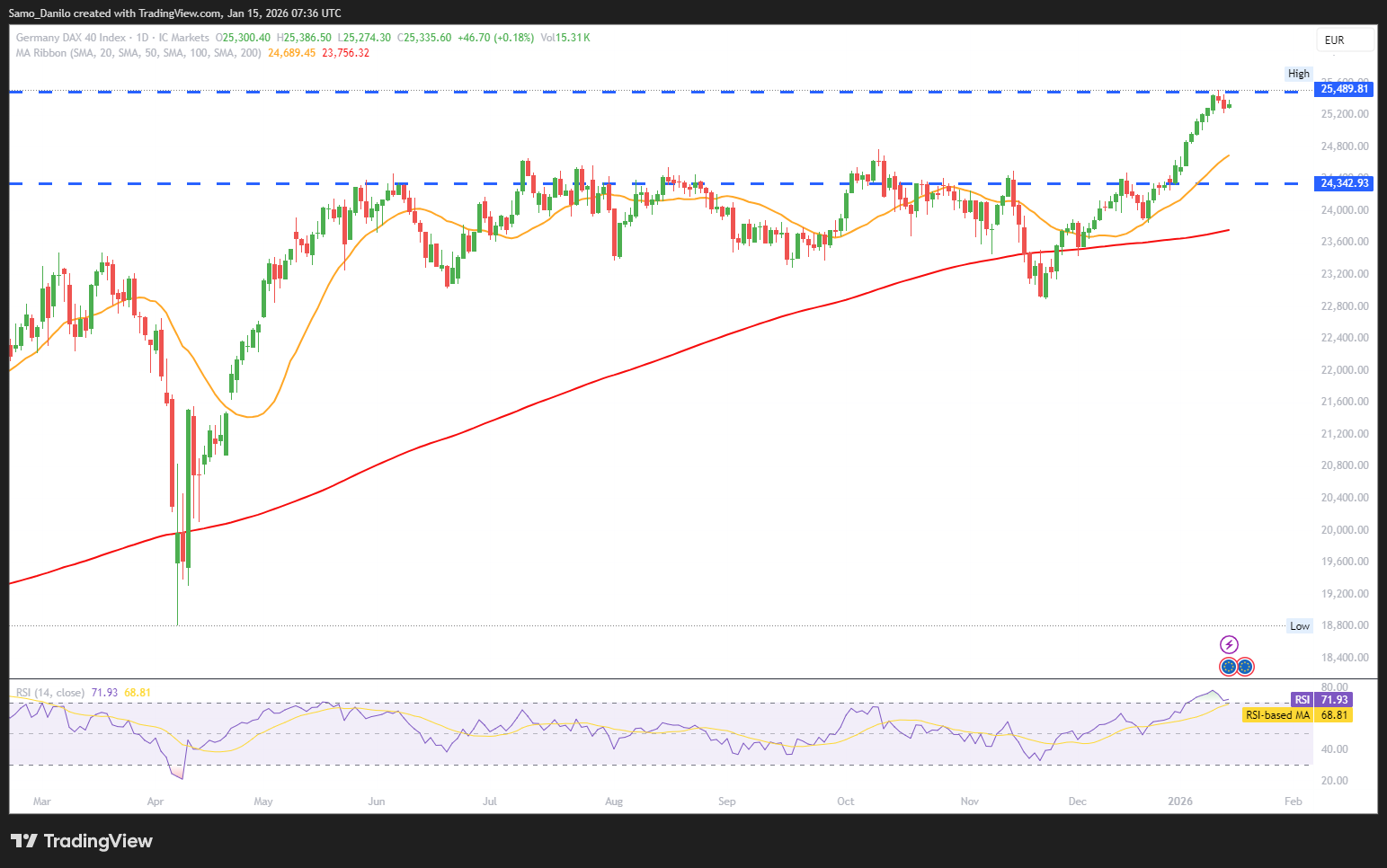
| SMA (20) | Rising | | |
| RSI (14) | Rising | | |
| MACD (12, 26, 9) | Rising | | |
Closing statement: The DAX remains resilient, supported by easing wholesale inflation and reduced political noise in Europe. Near-term direction hinges on the tone of Germany’s GDP release and US macro data. A benign growth signal could keep the index biased higher toward recent highs, while a weak GDP print may trigger short-term consolidation rather than a deeper pullback.