
EURUSD
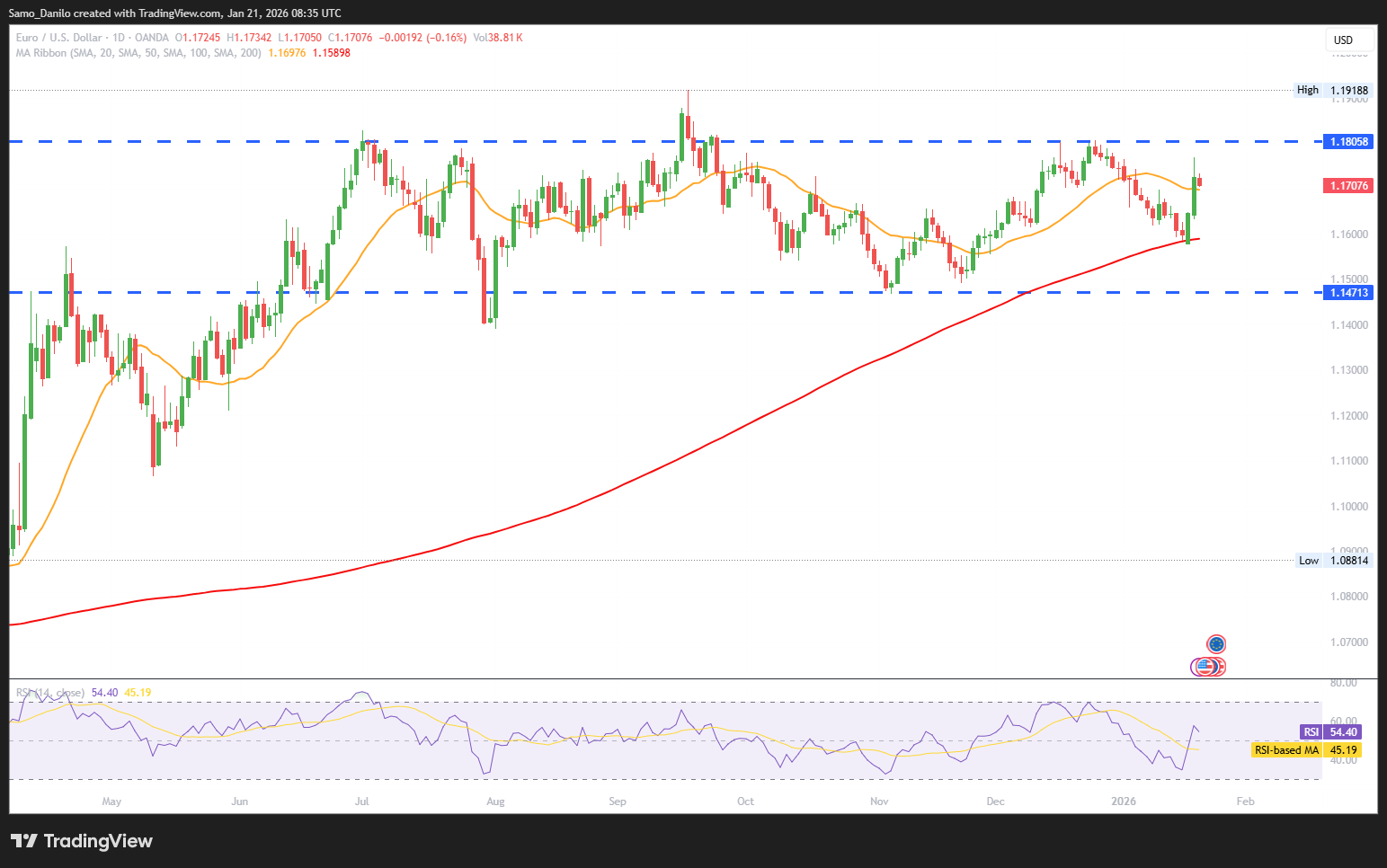
- EUR/USD Price: EUR/USD extends its rebound for a third straight session, trading around 1.1710, supported by broad USD weakness and improving Eurozone sentiment.
- US political risk: President Trump’s “no going back” stance on Greenland, alongside renewed 10% tariff threats on eight EU countries, has heightened concerns over global trade and US growth, weighing on the Dollar.
- Trade tensions: The European Parliament’s plan to suspend approval of the US trade deal agreed in July signals a clear escalation in transatlantic tensions, adding downside pressure to the USD and supporting the Euro in relative terms.
- Eurozone sentiment: The ZEW index surged to 40.8 in January (from 33.7), beating expectations and marking the strongest reading since mid-2024, reinforcing the narrative of improving growth expectations in the euro area.
- ECB communication: Multiple speeches from ECB President Lagarde and other Governing Council members are in focus, with markets watching for any hints on rate stability or risks tied to geopolitics and trade.
| SMA (20) | Slightly Rising |  |
|
| RSI (14) | Rising | | |
| MACD (12, 26, 9) | Slightly Falling |  |
Closing statement: EUR/USD remains bid on geopolitical risk and improving Eurozone sentiment, while the USD is pressured by trade uncertainty and political noise. As long as trade tensions dominate headlines, the pair could extend toward 1.1750–1.1800. However, any pushback from ECB officials against easing financial conditions, or a de-escalation in US–EU tensions, may trigger a near-term consolidation or pullback toward 1.1650.
GBPUSD
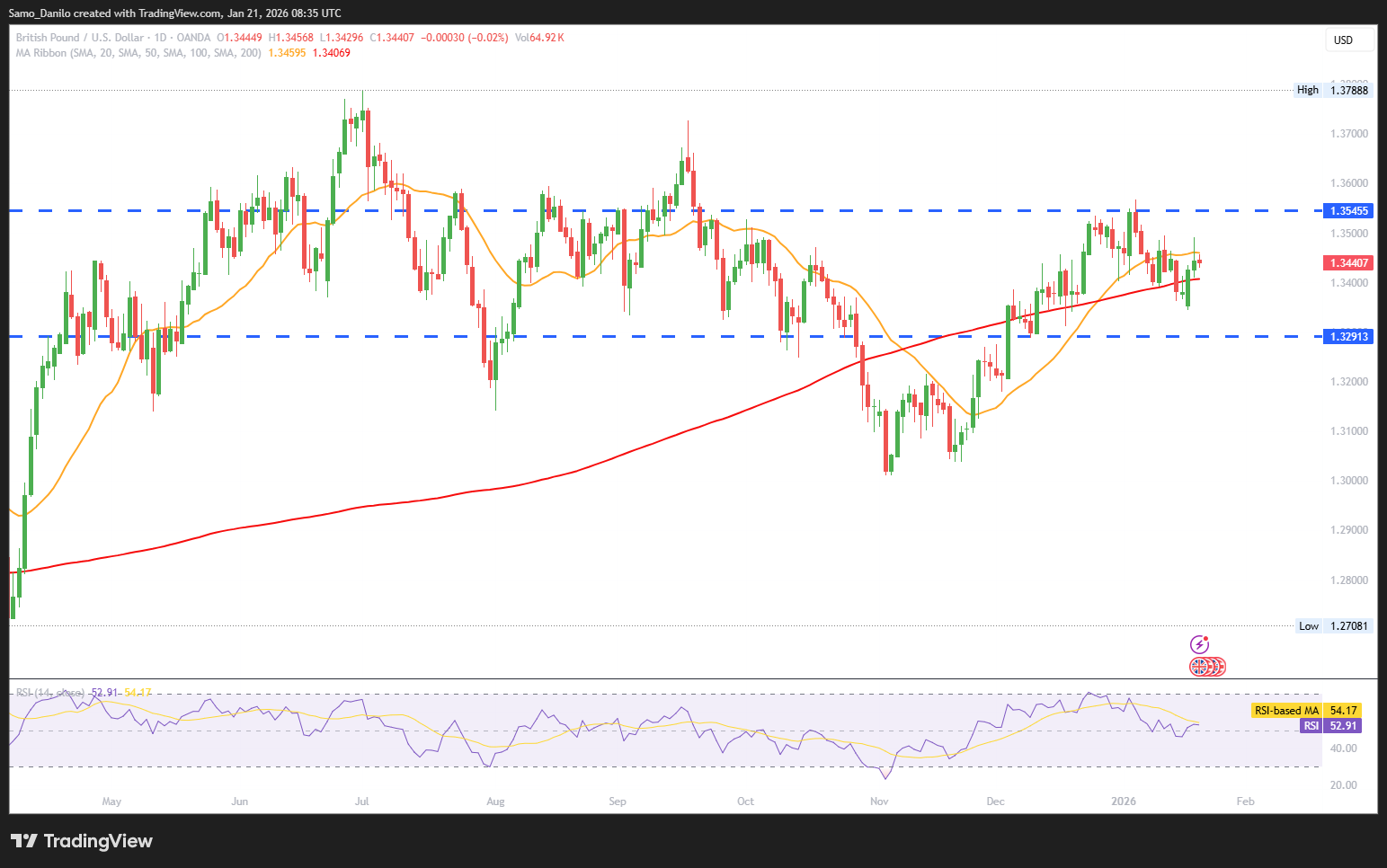
- GBP/USD Price: GBP/USD extends gains for a third consecutive session, trading near 1.3450, as the Pound benefits from resilient UK inflation data and stable risk sentiment.
- UK inflation: Headline CPI accelerated to 3.4% y/y in December (from 3.2%), while core inflation held at 3.2%, reinforcing expectations that the Bank of England will remain cautious about easing policy too quickly.
- US labor: The ADP employment report showed a weaker pace of job creation, with only 8,000 jobs added, slightly undermining the US Dollar.
- Geopolitical uncertainty: Trump’s ambiguous comments on Greenland continue to inject uncertainty into markets, though without immediate market-moving impact.
- Policy stance: US officials continue to stress patience, signaling no urgency to cut rates until inflation convincingly returns toward the 2% target.
| SMA (20) | Rising | | |
| RSI (14) | Slightly Rising | |
|
| MACD (12, 26, 9) | Slightly Rising | |
Closing statement: GBP/USD remains mildly bullish, supported by firmer UK inflation and a softer tone in US labor data. As long as the pair holds above the 1.3400–1.3420 support zone, further upside toward 1.3500 remains possible. However, sustained gains may be limited unless US data weakens further or UK inflation continues to surprise to the upside. A renewed hawkish Fed tone could cap upside and trigger a short-term pullback.
XAUUSD
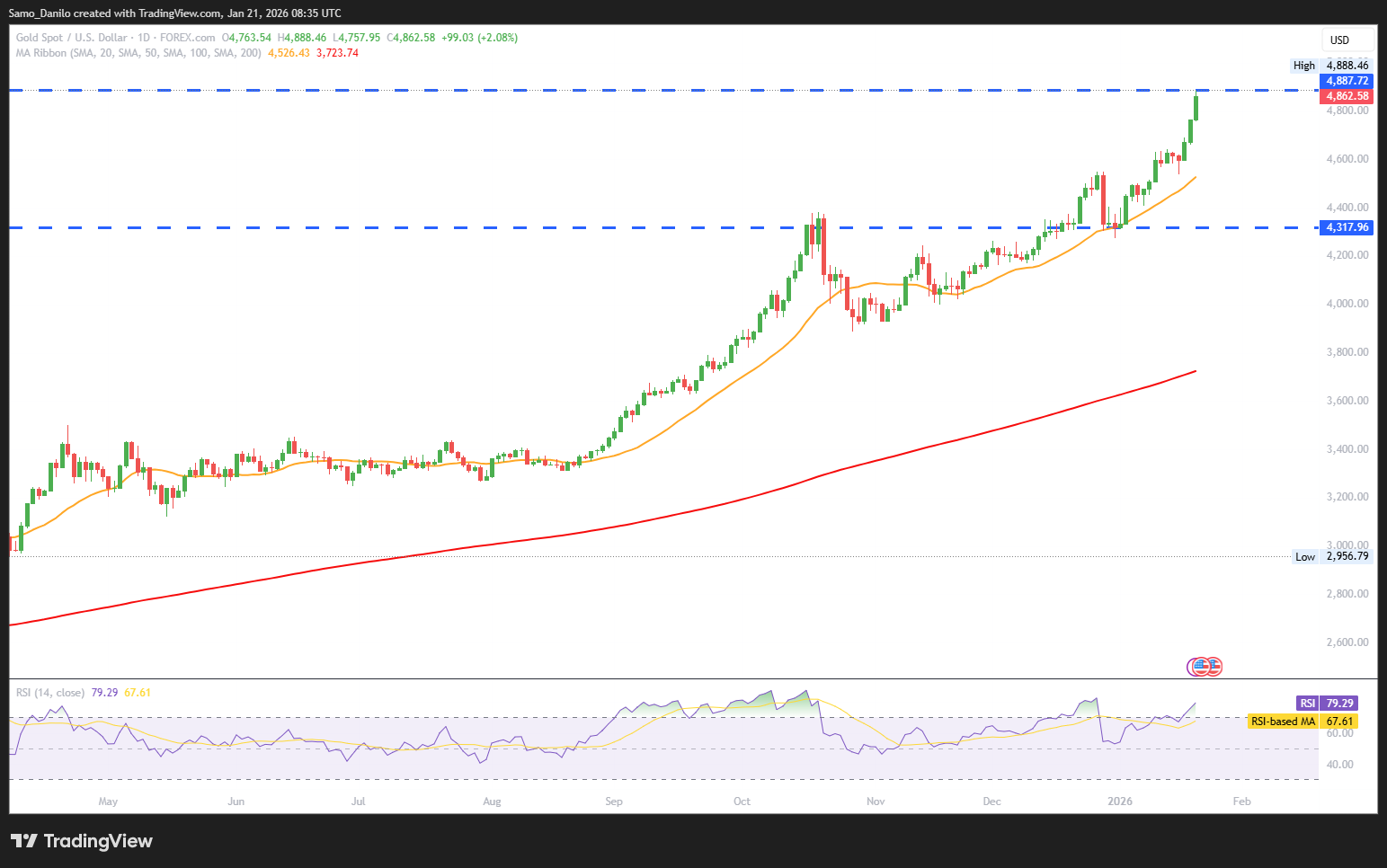
- XAU/USD Price: Gold extends its rally for a third consecutive session, printing fresh all-time highs near $4,850, supported by elevated geopolitical and macro uncertainty.
- Geopolitical tensions: Ongoing friction between the US and Europe over Greenland, combined with rising global bond yields, has reinforced demand for safe-haven assets.
- Policy expectations: Markets have trimmed expectations for additional Fed rate cuts in 2026 after Trump signaled continuity in economic leadership, which has added volatility but not dented gold’s appeal.
- Policy uncertainty: Trump’s comments regarding uncertainty over future tariff rulings by the Supreme Court have added to risk aversion, indirectly supporting bullion.
- Data ahead: Attention now turns to the US PCE Price Index, a critical inflation gauge that could shape expectations for Fed policy going forward.
| SMA (20) | Rising | | |
| RSI (14) | Rising | | |
| MACD (12, 26, 9) | Rising | | |
Closing statement: Gold remains firmly bullish, underpinned by geopolitical risks, policy uncertainty, and sustained demand for safe havens. As long as prices hold above the $4,750–4,780 zone, the bias remains upward, with scope for a push toward $4,900 and beyond. A softer-than-expected PCE print could accelerate gains, while a strong inflation surprise may trigger short-term profit-taking without necessarily breaking the broader uptrend.
CRUDE OIL
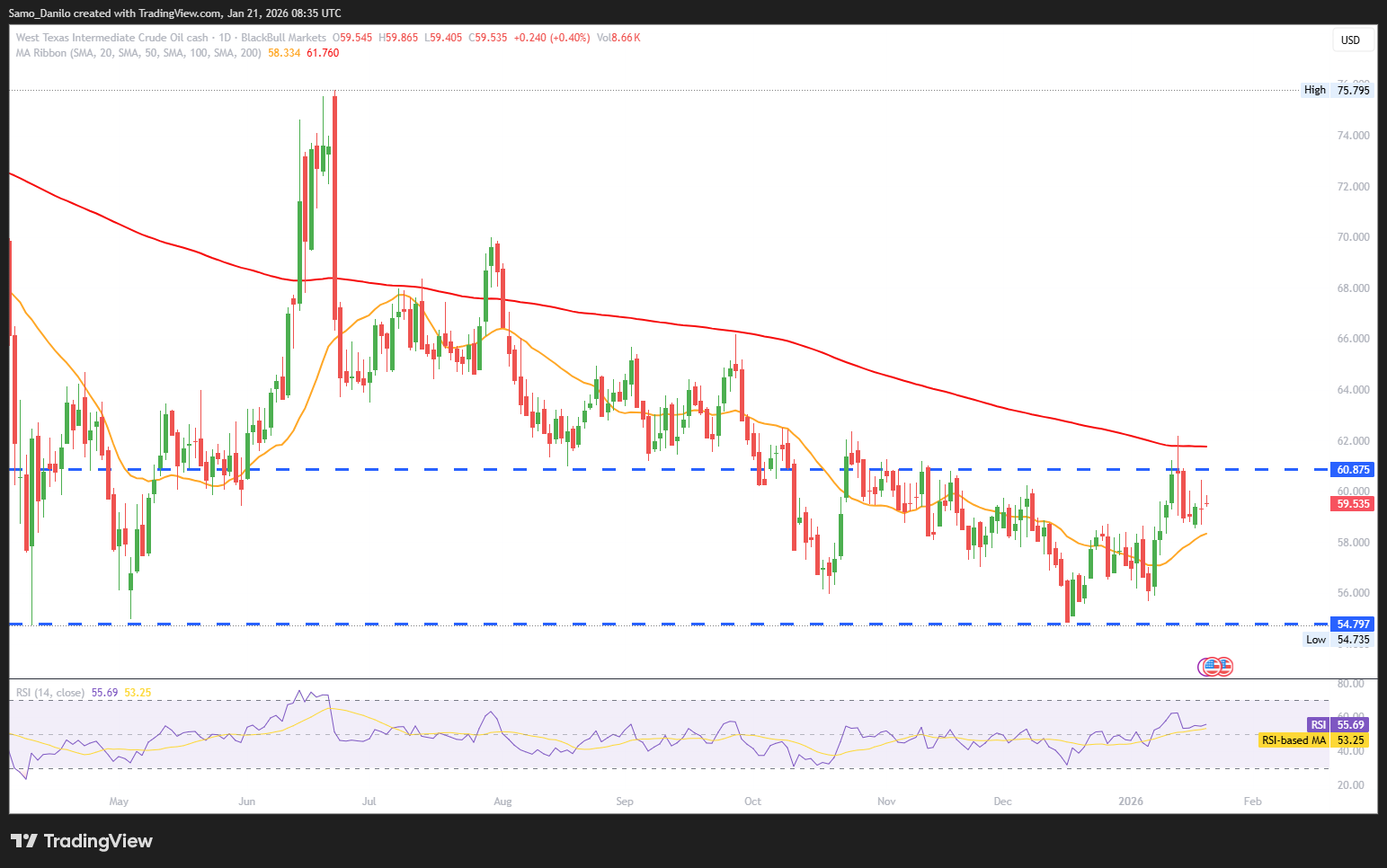
- Crude Oil Price: WTI trades near $59.60, supported by renewed supply-side concerns during early European trading.
- Kazakhstan supply: Output at the Tengiz and Korolev oilfields remains offline due to power issues, with production possibly halted for another 7–10 days, tightening near-term supply.
- US–Venezuela tensions: The seizure of a seventh Venezuela-linked oil tanker highlights Washington’s stricter enforcement of sanctions, adding a geopolitical risk premium to oil prices.
- Venezuela reforms: Caracas is moving toward loosening PDVSA’s grip on oil projects, potentially increasing foreign involvement and future output, though near-term effects remain limited.
- OPEC dynamics: Equatorial Guinea’s push for prepaid oil and LNG deals underscores financial stress among smaller OPEC producers, reinforcing concerns over supply stability.
| SMA (20) | Slightly Falling | |
| RSI (14) | Slightly Rising | |
| MACD (12, 26, 9) | Slightly Rising | |
Closing statement: WTI remains supported on supply-side risks, particularly from Kazakhstan outages and tighter enforcement on Venezuelan exports. As long as prices hold above the $58.50–59.00 support zone, upside potential toward $61.00 remains intact. However, any easing of geopolitical tensions or signs of rising global inventories could cap gains and trigger short-term consolidation.
DAX
- DAX Price: The DAX holds firm around 24,600 points following last week’s record highs, showing resilience amid mixed global signals.
- Positive sentiment: Germany’s ZEW Economic Sentiment Index soared to 59.6 in January, the highest since July 2021 and well above forecasts, reflecting strong optimism for a 2026 economic rebound despite lingering US trade uncertainties.
- Stock spotlight: Barclays raised its price target for Rheinmetall from €2,060 to €2,175 and reaffirmed an "Overweight" rating, signaling confidence in select industrial stocks.
- Trade tensions: Trump’s threat of a 200% tariff on French wines after Macron declined to join his “Board of Peace” adds fresh geopolitical risks.
- ECB concerns: ECB President Christine Lagarde highlighted how US-EU trade disputes could significantly impact Germany’s economy more than France’s, with tariffs potentially pushing inflation slightly higher.
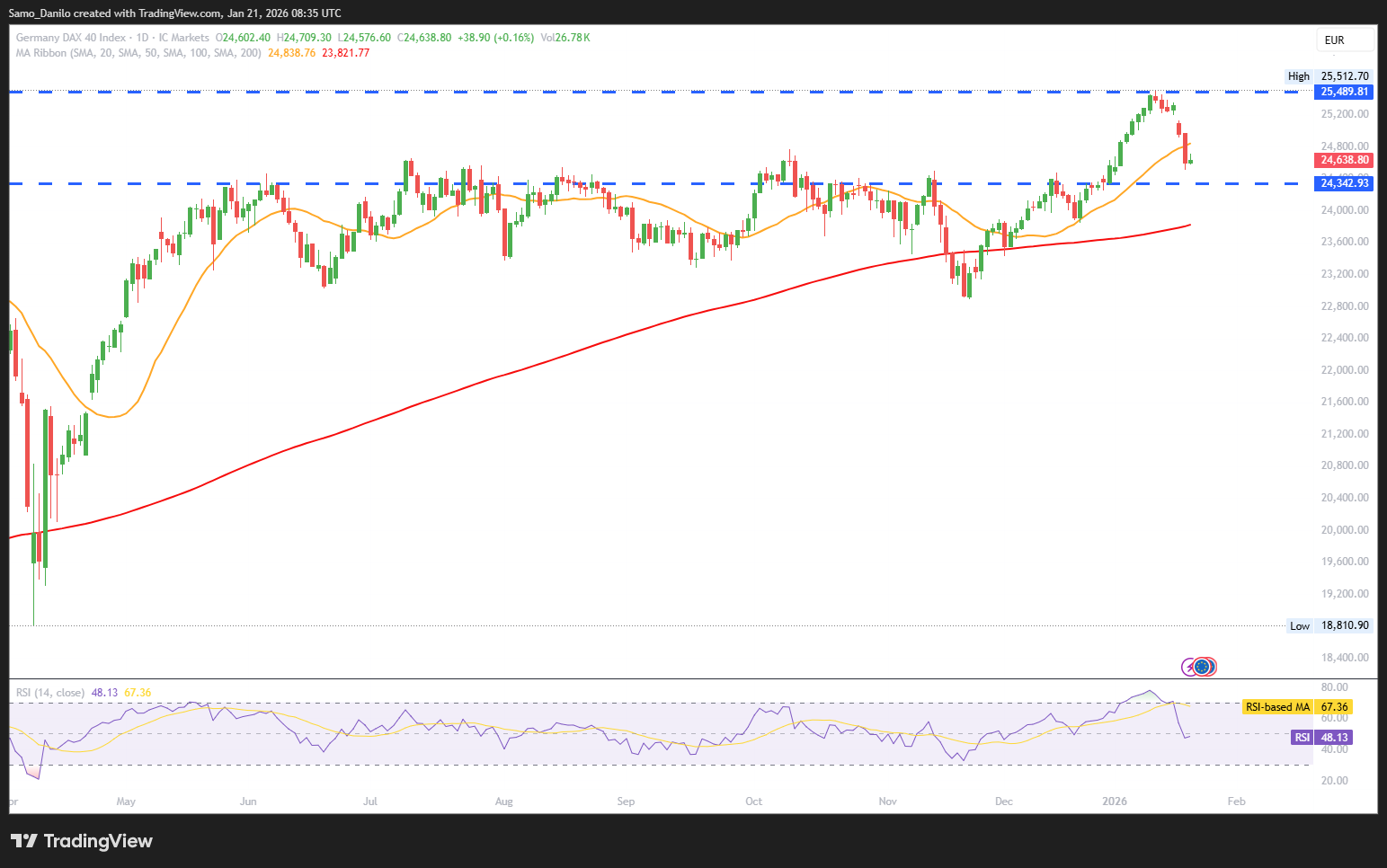
| SMA (20) | Rising | | |
| RSI (14) | Falling | | |
| MACD (12, 26, 9) | Slightly Rising | |
Closing statement: The DAX remains supported by improving German business sentiment and selective corporate upgrades but faces headwinds from escalating US-EU trade tensions. Investors should watch for further developments on tariffs and ECB commentary, which could influence market volatility. The index may consolidate near current levels around 24,600–25,000 unless fresh catalysts emerge.