
EURUSD
- EUR/USD Price: The EUR/USD pair loses ground toward 1.1425 during the early European trading session on Wednesday.
- Oil prices: Scotiabank strategists noted that the renewed decline in oil prices is positive for the Euro, given the euro area’s dependence on energy imports and its terms of trade. Cheaper energy could therefore provide some support to the region’s external balance and the single currency.
- Consumer confidence: Eurozone consumer confidence fell more than expected in September to -16.5, compared with expectations of -16.0 and August’s -15.5 reading. The decline ended four consecutive months of improvement and was likely influenced by the recent rise in energy costs.
- Employment numbers: The latest ADP weekly estimate showed private employment growth at 20.0K, based on a four-week rolling average through September 5. The figure increased from a revised 16.75K in the previous week, pointing to a modest improvement in private-sector employment momentum.
- Data ahead: September’s eurozone flash PMI data will be closely watched for clues about the European Central Bank’s policy outlook. Current expectations are for the figures to confirm that relatively solid growth momentum continued into September.
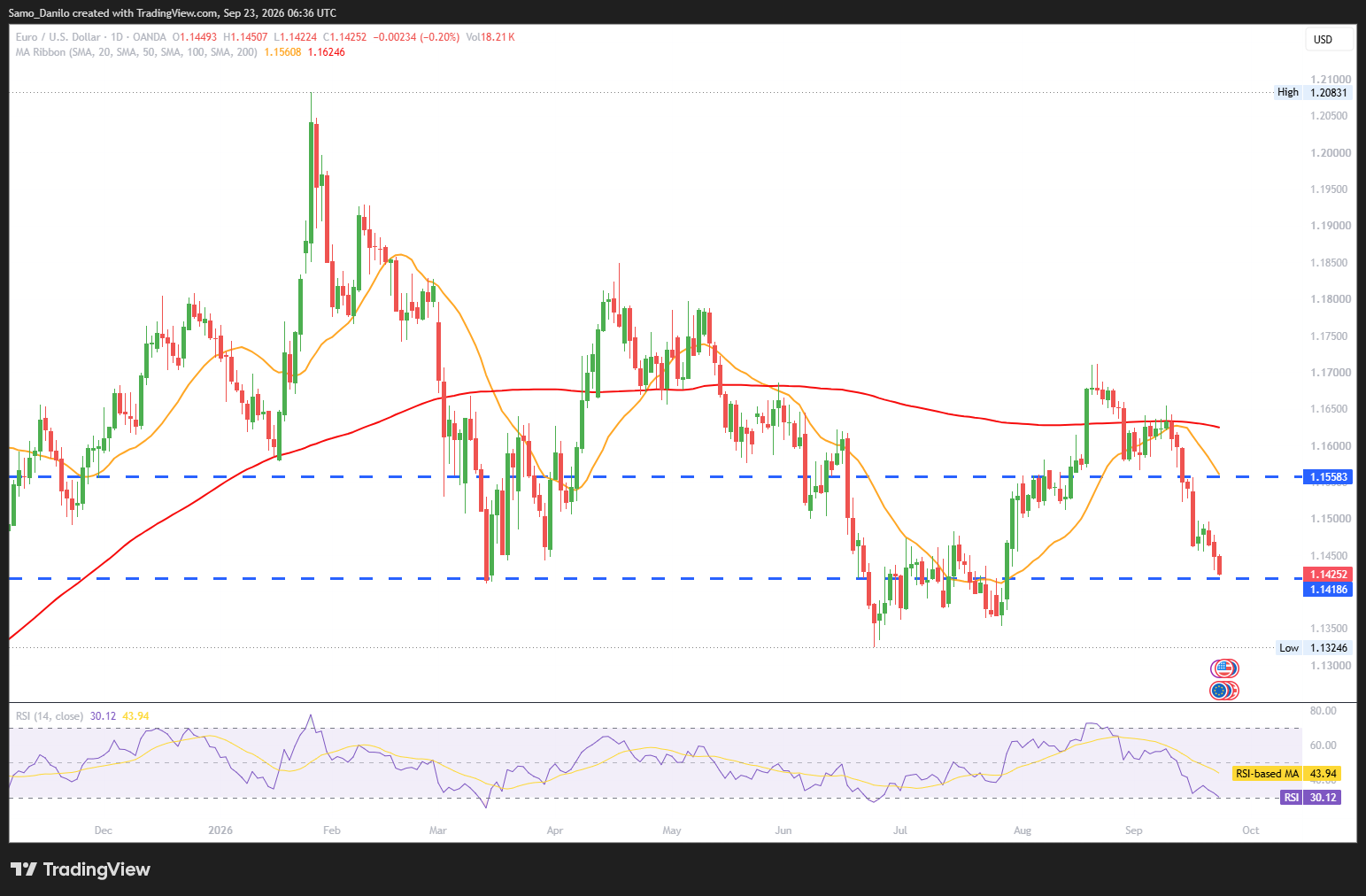
| SMA (20) | Falling |  | |
| RSI (14) | Falling | | |
| MACD (12, 26, 9) | Falling | | |
Closing statement: EUR/USD remains under pressure near 1.1425, while weaker eurozone consumer confidence adds to the near-term challenges for the Euro. However, lower oil prices and expectations for continued growth momentum in the euro area could provide some support, with the flash PMIs likely to be the key catalyst for the pair’s next move.
GBPUSD
- GBP/USD Price: The GBP/USD pair attracts fresh selling pressure around 1.3310 during the early European trading session on Wednesday.
- UK borrowing: UK public sector borrowing reached £18.27 billion in August, significantly above the market forecast of £15.35 billion and the £2.04 billion recorded in July. The larger-than-expected borrowing figure highlights increasing pressure on the UK’s public finances and could weigh on the Pound.
- Finance pressure: Chancellor John Healey is expected to face pressure to raise taxes or reduce spending at next month’s budget. Higher borrowing costs linked to the Iran war, combined with weaker economic growth, have reportedly reduced the government’s fiscal headroom by almost £12 billion.
- Rate hike: St. Louis Fed President Alberto Musalem said on Monday that additional interest-rate increases may be necessary to bring inflation back to the Federal Reserve’s target.
- UK PMI: September’s UK flash PMI figures will be released on Wednesday and are expected to remain broadly unchanged. Economic activity has held up relatively well over the summer, with August’s composite PMI reaching 52.5, its highest level since April.
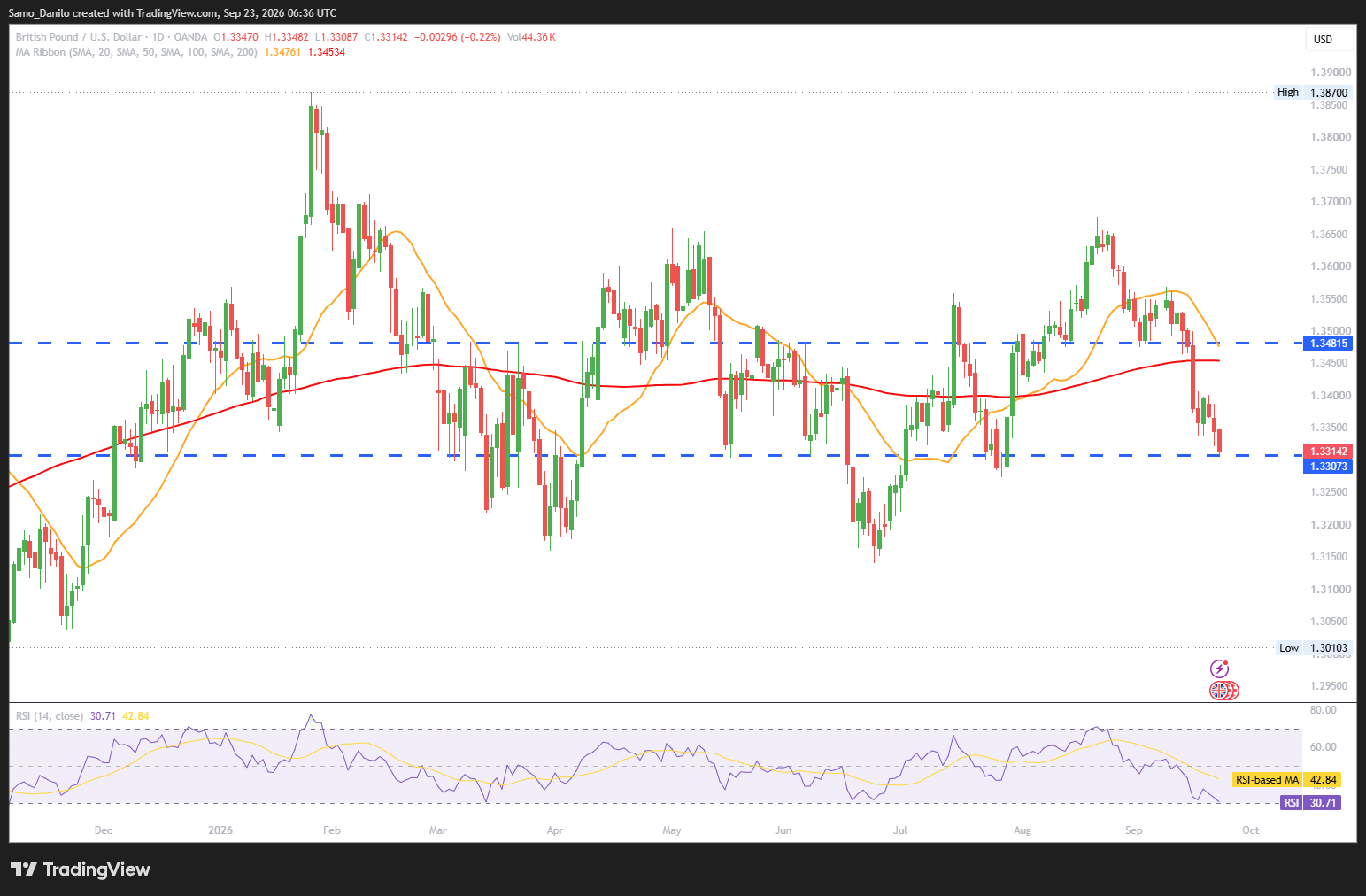
| SMA (20) | Falling | | |
| RSI (14) | Falling | | |
| MACD (12, 26, 9) | Falling | | |
Closing statement: GBP/USD remains under pressure near 1.3310 as rising UK borrowing and shrinking fiscal headroom weigh on the Pound. At the same time, expectations for further Fed rate increases could support the US Dollar, while the UK flash PMIs will provide an important test of the economy’s recent resilience.
XAUUSD
- XAU/USD Price: Gold (XAU/USD) struggles to extend the previous day’s rebound from below $4,300 and comes under renewed selling pressure during the Asian session on Wednesday.
- Pressure on Iran: President Trump used his UN speech to warn that he could “annihilate the Islamic Republic” if no agreement is reached, while saying that a peace deal is unlikely before the November mid-terms.
- Greenland agreement: The US, Denmark and Greenland signed a new Arctic security agreement at the UN General Assembly in New York. The deal allows the US to expand its military presence in Greenland, including new sites at Narsarsuaq and Mestersvig, an expansion of the Pituffik Space Base and the possible deployment of a “Golden Dome” missile-defence system.
- Fed's Collins: Boston Fed President Susan Collins said she supported the Federal Reserve’s decision last week to raise interest rates amid risks that inflation could remain above the 2% target.
- Flash PMIs: September’s US flash PMI figures are expected to remain comfortably above the 50 level, with manufacturing projected at 53.6 and services at 56.0. Strong August readings already indicated resilient economic activity, and another solid release could reinforce expectations for continued strength in the US economy.
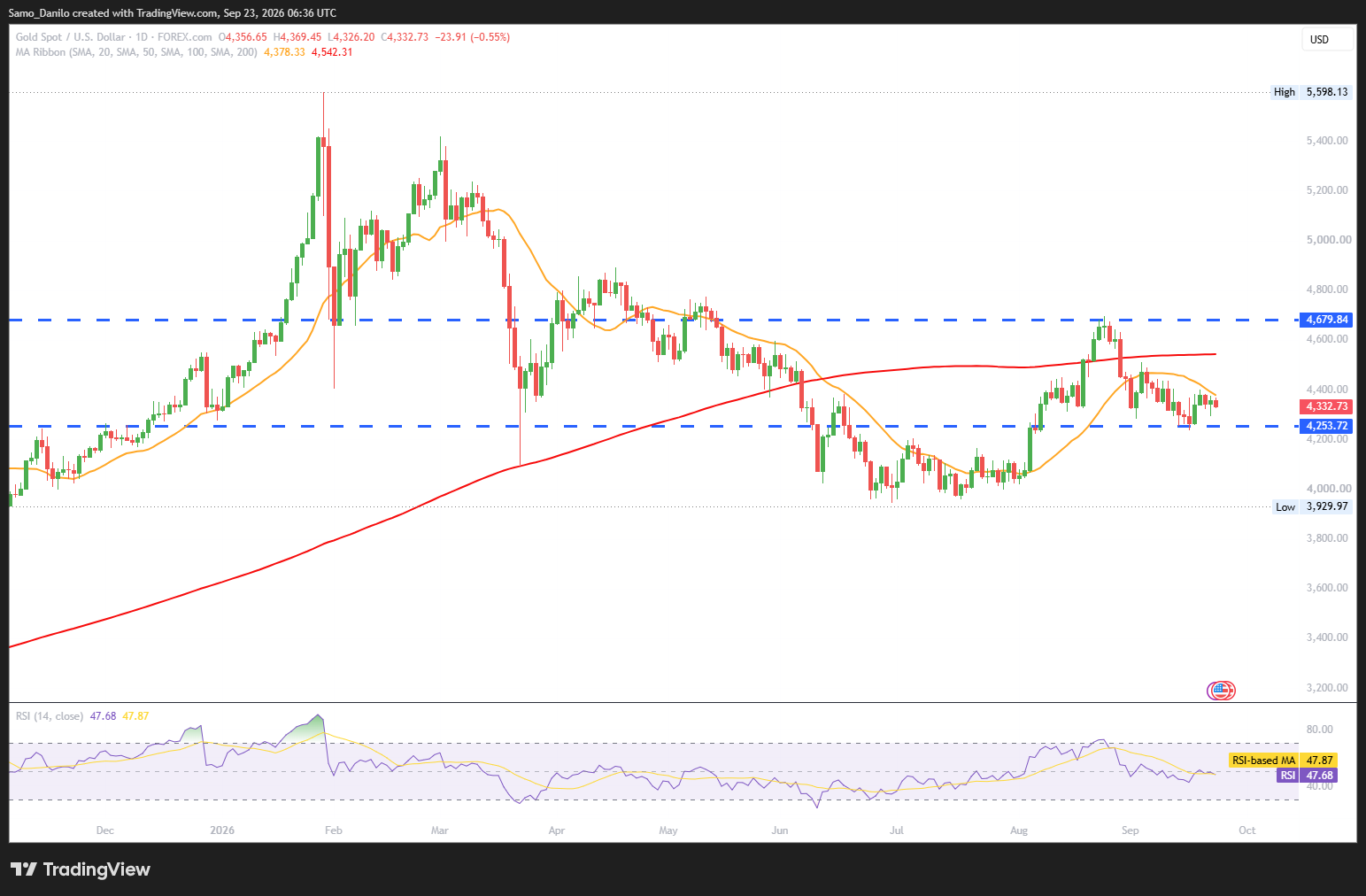
| SMA (20) | Falling | | |
| RSI (14) | Slightly Rising |  |
|
| MACD (12, 26, 9) | Slightly Falling | |
Closing statement: XAU/USD remains under pressure after failing to sustain its rebound from below $4,300, while expectations for solid US activity and a hawkish stance from the Fed create headwinds for gold. However, elevated tensions involving Iran and the broader geopolitical developments around Greenland could continue to support safe-haven demand and increase volatility.
CRUDE OIL
- Crude Oil Price: West Texas Intermediate (WTI), the benchmark US crude oil price, falls for a sixth consecutive day toward the $92.90 region during Tuesday’s European session.
- Strait of Hormuz: Iranian Foreign Minister Abbas Araghchi met with US Special Envoy Steve Witkoff to restate Tehran’s conditions for reopening the Strait of Hormuz. President Trump said the discussions went well but provided no further details.
- Crude inventories: Weekly API data showed US crude oil inventories increased by 1.8 million barrels, compared with a 7.1 million-barrel build in the previous week. The smaller increase suggests less accumulation than in the prior reading and could provide some support to oil prices despite the broader downward trend.
- Export ban: President Trump said he supports a potential ban on US diesel fuel exports amid record-high prices at the pump. Restricting exports could increase domestic diesel availability.
- Norwegian oil: Norway’s crude oil production increased to 1.882 million barrels per day in August, exceeding the Norwegian Offshore Directorate’s forecast. However, output remained below the level recorded during the same month last year, limiting the significance of the increase for overall supply growth.
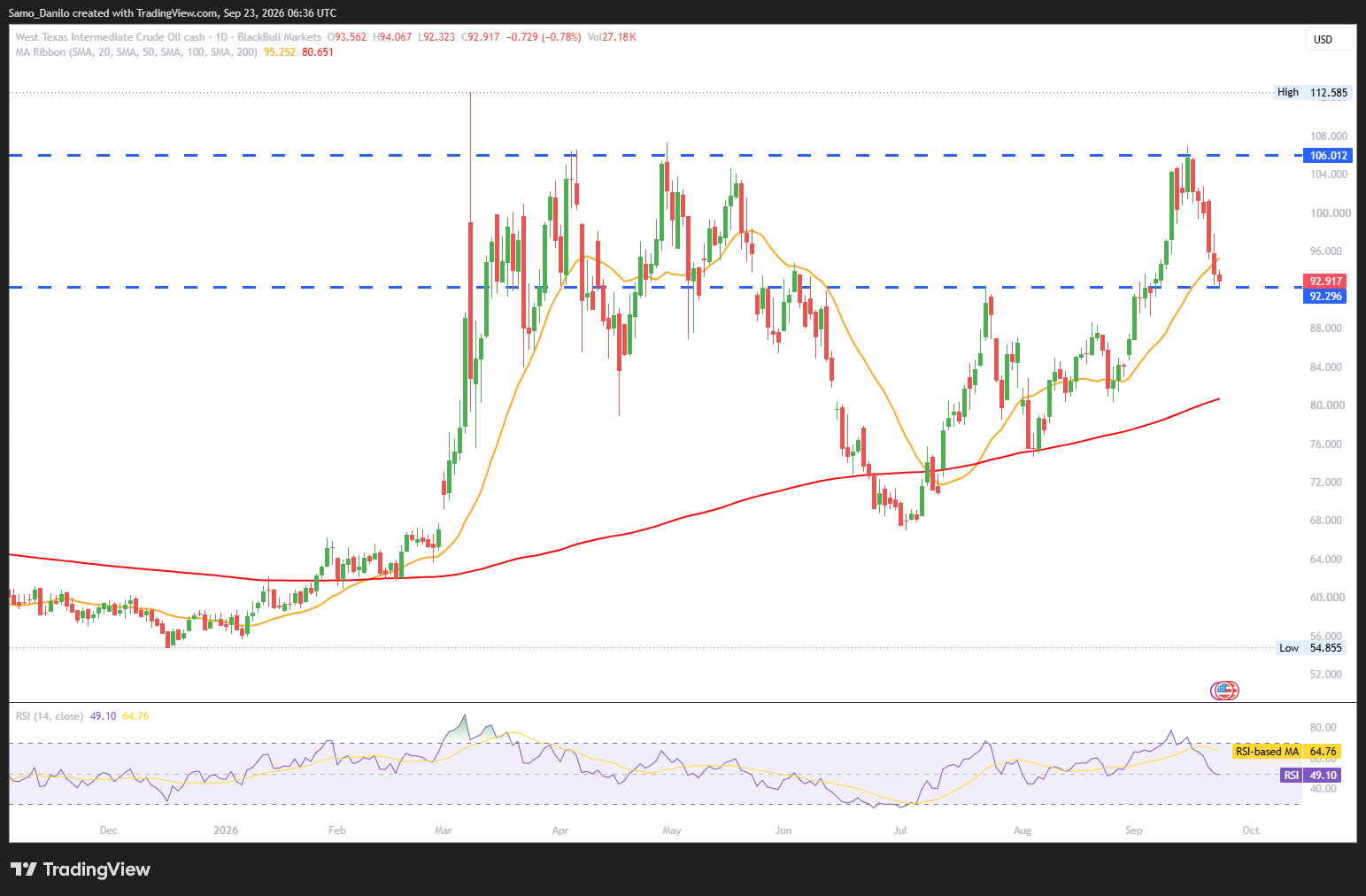
| SMA (20) | Rising | | |
| RSI (14) | Falling | | |
| MACD (12, 26, 9) | Rising | | |
Closing statement: WTI remains under pressure near $92.90 after six consecutive sessions of declines, while uncertainty surrounding the Strait of Hormuz remains a key factor for the market. The smaller US inventory build and lower year-on-year Norwegian production could provide some support, but developments around Hormuz and US diesel-export policy are likely to remain important for the next move.
DAX
- DAX 40 Price: The DAX 40 trades higher above the 25,700-point level during Tuesday’s European morning session.
- Wage negotiations: Germany’s IG Metall union is set to decide on its demands for the upcoming wage negotiations covering the metalworking and electrical engineering industries.
- Siemens mobility: Austrian Federal Railways (OeBB) awarded a multibillion-euro contract to Siemens Mobility and Japanese rail technology group Hitachi Rail to digitize its signaling systems.
- Mercedes-Benz: Mercedes-Benz and UK-based start-up Wayve announced an agreement to integrate Wayve’s autonomous-driving technology into future Mercedes vehicles. The integration is expected to begin over the next two years, highlighting the German automaker’s continued investment in advanced vehicle technology.
- PMI data: Traders are preparing for preliminary Purchasing Managers’ Index (PMI) readings from Germany, the euro area and the US, due later on Wednesday.
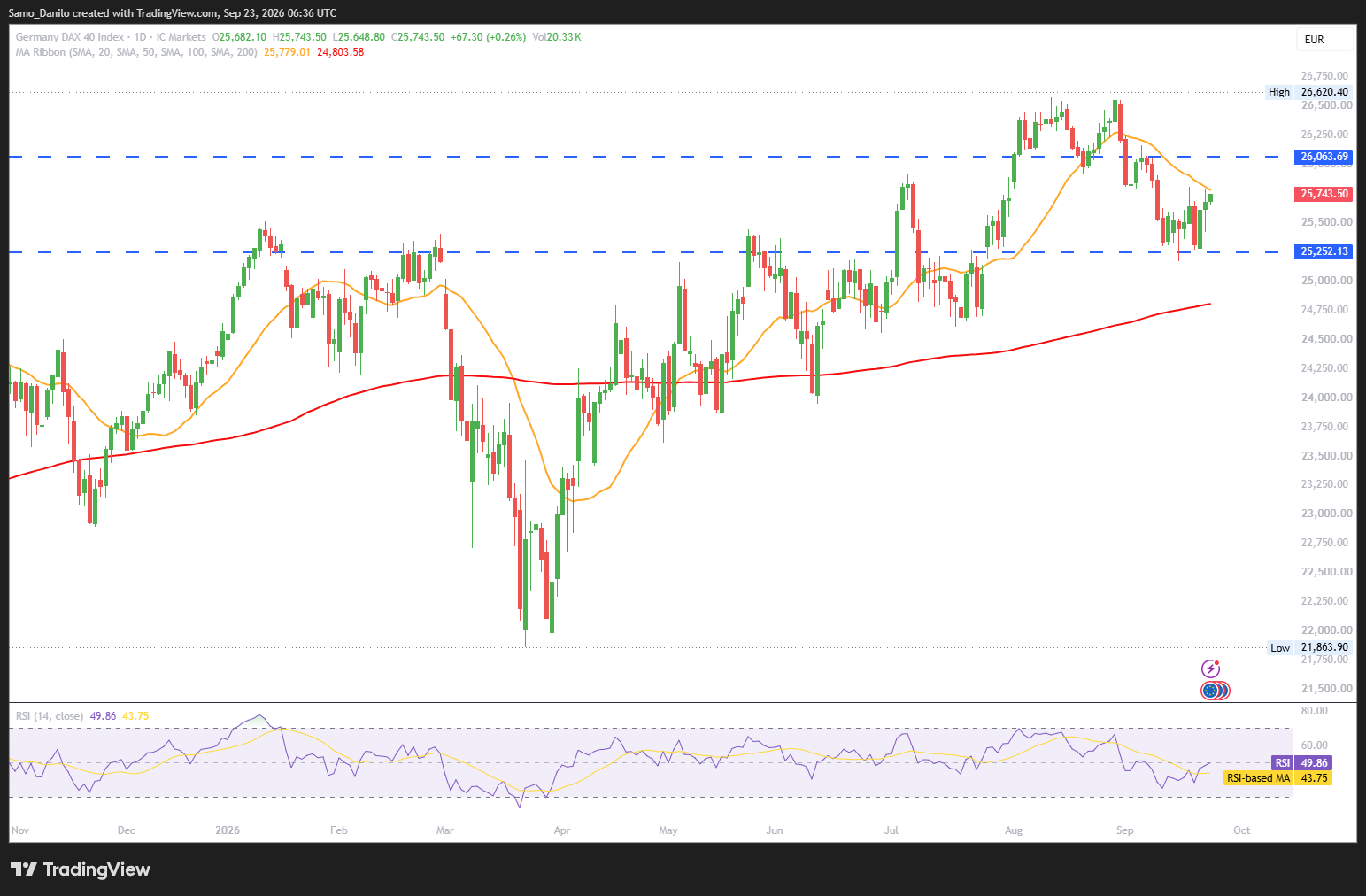
| SMA (20) | Slightly Falling | |
|
| RSI (14) | Slightly Falling | |
|
| MACD (12, 26, 9) | Falling | | |
Closing statement: The DAX 40 remains above 25,700 as investors assess developments in Germany’s industrial sector and corporate technology investments. However, Wednesday’s preliminary PMI data from Germany, the euro area and the US will be the key near-term catalyst for the index and could determine the next direction of European equities.